KayaWell

ALS

KayaWell Icon

Amyotrophic lateral sclerosis (ALS) is a rare group of neurological diseases that mainly involve the nerve cells (neurons) responsible for controlling voluntary muscle movement. Voluntary muscles produce movements like chewing, walking, breathing and talking. The disease is progressive, meaning the symptoms get worse over time. Currently, there is no cure for ALS and no effective treatment to halt, or reverse, the progression of the disease.


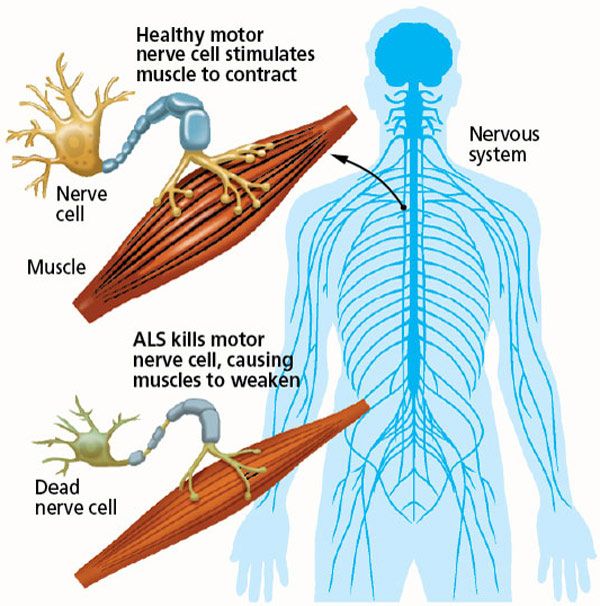
ALS belongs to a wider group of disorders known as motor neuron diseases, which are caused by gradual deterioration (degeneration) and death of motor neurons. Motor neurons are nerve cells that extend from the brain to the spinal cord and to muscles throughout the body. These motor neurons initiate and provide vital communication links between the brain and the voluntary muscles.


Messages from motor neurons in the brain (called upper motor neurons) are transmitted to motor neurons in the spinal cord and to motor nuclei of brain (called lower motor neurons) and from the spinal cord and motor nuclei of brain to a particular muscle or muscles.


In ALS, both the upper motor neurons and the lower motor neurons degenerate or die, and stop sending messages to the muscles. Unable to function, the muscles gradually weaken, start to twitch (called fasciculations), and waste away (atrophy). Eventually, the brain loses its ability to initiate and control voluntary movements.


Early symptoms of ALS usually include muscle weakness or stiffness. Gradually all muscles under voluntary control are affected, and individuals lose their strength and the ability to speak, eat, move, and even breathe.


Most people with ALS die from respiratory failure, usually within 3 to 5 years from when the symptoms first appear. However, about 10 percent of people with ALS survive for 10 or more years.


The onset of ALS can be so subtle that the symptoms are overlooked but gradually these symptoms develop into more obvious weakness or atrophy that may cause a physician to suspect ALS. Some of the early symptoms include:

fasciculations (muscle twitches) in the arm, leg, shoulder, or tongue
muscle cramps
tight and stiff muscles (spasticity)
muscle weakness affecting an arm, a leg, neck or diaphragm.
slurred and nasal speech
difficulty chewing or swallowing.
For many individuals the first sign of ALS may appear in the hand or arm as they experience difficulty with simple tasks such as buttoning a shirt, writing, or turning a key in a lock.  In other cases, symptoms initially affect one of the legs, and people experience awkwardness when walking or running or they notice that they are tripping or stumbling more often.

When symptoms begin in the arms or legs, it is referred to as “limb onset” ALS.  Other individuals first notice speech or swallowing problems, termed “bulbar onset” ALS.

Regardless of where the symptoms first appear, muscle weakness and atrophy spread to other parts of the body as the disease progresses. Individuals may develop problems with moving, swallowing (dysphagia), speaking or forming words (dysarthria), and breathing (dyspnea).  

Although the sequence of emerging symptoms and the rate of disease progression vary from person to person, eventually individuals will not be able to stand or walk, get in or out of bed on their own, or use their hands and arms.

Individuals with ALS usually have difficulty swallowing and chewing food, which makes it hard to eat normally and increases the risk of choking. They also burn calories at a faster rate than most people without ALS. Due to these factors, people with ALS tend to lose weight rapidly and can become malnourished.

Because people with ALS usually retain their ability to perform higher mental processes such as reasoning, remembering, understanding, and problem solving, they are aware of their progressive loss of function and may become anxious and depressed.

A small percentage of individuals may experience problems with language or decision-making, and there is growing evidence that some may even develop a form of dementia over time.

Individuals with ALS will have difficulty breathing as the muscles of the respiratory system weaken. They eventually lose the ability to breathe on their own and must depend on a ventilator. Affected individuals also face an increased risk of pneumonia during later stages of the disease. Besides muscle cramps that may cause discomfort, some individuals with ALS may develop painful neuropathy (nerve disease or damage).
It is unclear exactly what causes ALS. There are different types, according to their signs and symptoms and whether or not there is a clear genetic association.

ALS can be sporadic or familial.

Sporadic ALS occurs randomly, and it accounts for 90 to 95 percent of cases. There is no clear risk factor or cause.

Familial ALS is inherited. Around 5 to 10 percent of cases are familial. The child of a person with ALS will have a 50 percent chance of developing the condition. Rarely, it can affect a person in their teens. Researchers are investigating which genes are involved.

Other possible causes of ALS include:

Disorganized immune response: The immune system may attack some of the body's cells, possibly killing nerve cells.
Chemical imbalance: People with ALS often have higher levels of glutamate, a chemical messenger in the brain, near the motor neurons. Glutamate in high quantities is known to be toxic to nerve cells.
Mishandling of proteins: If proteins are not processed correctly by nerve cells, abnormal proteins could potentially accumulate and cause the nerve cells to die.
Possible environmental factors
Environmental factors may also play a role.

One study has reported that military personnel deployed in the Gulf region during the 1991 war were more likely to develop ALS than military personnel deployed elsewhere.

Some possible links have been found between ALS and exposure to:

mechanical or electrical trauma
military service
high levels of exercise
high levels of agricultural chemicals
high levels of a variety of heavy metals
However, there is no conclusive evidence that specific lifestyle changes can decrease the risk.
https://www.ninds.nih.gov
https://www.medicalnewstoday.com

ALS

Comments